View download the awards brochure here

Employers have been urged to do more to encourage social connections between remote staff after a survey revealed that nearly two thirds of Brits find it difficult to make work friends while working from home.
A poll of 2,500 UK workers, conducted by OC Tanner as part of its Global Culture Report, found 63% of people said it was more challenging forming new friendships with colleagues while working remotely.
Over half of those polled (58%) also admitted that the office was where most of their new friendships are formed, while 71% of UK workers said they valued colleague interactions.
The research also found that 71% of employees found it easier to make personal connections with people from other generations when in the office, while the same percentage felt they are more able to make friendships with people of different cultures in an office environment.
The findings come as employers were urged to focus on improving flexible working, employee wellbeing and other areas of workplace culture in order to attract talent in an increasingly competitive market.
The People Management article can be found here, while the full Global Culture Report can be found via this link.
According to Personnel Today, organisations should ensure that they are on top of the raft of employment law developments that will apply in April 2022.
There are 6 changes that need to be considered, which are: –
Employers are encouraged to make sure that they are aware of changes to legislation so that they are in a position to act appropriately.
Full details of the Personnel Today News Article can be accessed via this link.
According to the Policy Exchange, it increasingly looks like the end of the era of expansion for Britain’s higher education sector. For the past 30 years parents and young people have seen higher education as the only route to safety and success, as a growing number of mainstream jobs became graduate only. But is this about to change?
The Government recently announced new measures to raise minimum standards in the education sector which means that, in order to avoid sanctions for high numbers of students not continuing or completing courses and not going on to decent roles, colleges will have to show that 60% of students end up in professional jobs.
This is part of a set of measures designed to raise standards and end the “bums on seats” reflex of some institutions, which are sometimes better at marketing their courses than producing well educated students.
Universities are clearly producing too many students for too few graduate jobs, notwithstanding the rise and rise of the graduate only job. Around one third of graduates are not in graduate employment 5 to 10 years after graduating, and the graduate income premium has declined to almost nothing for less prestigious universities.
It is argued that this academic-generalist model has led to two sets of disgruntled people, the people who didn’t go to university at all who feel like they are losing out when all the best jobs are reserved for graduates and the bottom part of the graduate class who are not getting the well paid professional jobs they expected. This problem is not going away because the number of top jobs is inherently limited and there has been a marked slow-down even in the broader category of professional and managerial jobs.
To read the full Policy Exchange comment please click here.
It is known that poverty at any stage in life can lead to negative impacts. It is therefore critical to scrutinise the data thoroughly to work out who is worst affected, determine how trends are changing over time and see what future prospects are.
The Joseph Rowntree Foundation has recently published a report looking at poverty at the start of 2022, nearly two years after the start of global pandemic. To an extent the full picture of UK poverty is unclear as official poverty data covering the pandemic period is not yet available, but many sources make it clear that while some groups have been well supported and face better prospects as we enter 2022, others face deep and persistent poverty. In some ways the position is much better than might be expected given the economic and social shock the country has been through.
While gross domestic product (GDP) is projected to recover to its pre-pandemic level by the start of 2022 and the rise in unemployment has been much smaller than the dire initial forecasts thanks largely to furlough, there have been changes to the taper rate to Universal Credit support for in-work families alongside the re-linking of housing support welfare to housing costs following a freeze in rates over several years.
Additionally, the £20 uplift to Universal Credit has now been withdrawn, while those on ‘legacy’ benefits (excluding Working Tax Credit) pre-dating Universal Credit received no increased support at all.
Families receiving these types of benefits have very high levels of poverty, with 43% of households in receipt of Universal Credit being food insecure. This has meant the basic rate of ‘out of work’ benefits is at its lowest for 30 years after adjusting for inflation, while in comparison, earnings have risen by more than a quarter over the same period.
Low-income households have less of a buffer against rising costs or any unexpected expenses, given they are less likely than other households to have savings. In terms of how all this plays out for future poverty levels, it seems clear that out-of-work families will fare worse than low-income families in work. There is already a large existing gap in the latest data, with only 6% of working-age adults in families where all adults are in full-time work being in poverty compared with almost half of working-age adults in workless families.
Furthermore, within inflation predicted to increase sharply in 2022 there seems little prospect of reversing these trends as child poverty rose by 4% from 2012/13 to almost a third of children by 2019/20, while and rising pensioner poverty rose by 5% to almost a fifth of pensioners by 2019/20.
To see the summary findings of Joseph Rowntree Foundation report please click here. The full report can also be accessed via this link: Full JRTF Report.
PwC, Unicef and Generation Unlimited have been working together to look at the challenges facing young people trying to start their careers and find employment.
Today, the world has 1.3bn young people who are trying to start out, find their way and make a life. But the harsh reality is that millions of these young people will find it hard to make a life for themselves because they will struggle to find work.
While the youth population has exploded by 30% in the last 20 years or so, the number in the labour force has actually decreased by approximately 12%. The COVID-19 pandemic has made it even tougher for young people to find a job.
When a young person wants to work but lacks the opportunity to do so, that is a tragedy both for the individual and for society. And one of the reasons that youth in every region struggle to find work is a mismatch between the skills they can offer and the skills employers need.
This is why UNICEF and PwC have partnered with Generation Unlimited to develop a practical road map to help young people understand what skills employers want, how to acquire those skills and get the certifications to prove it. This is called ‘reaching YES’ (youth employment and skilling).
The aim is to work in partnerships with government, businesses, multilateral organisations and young people themselves to achieve this. Helping young people acquire the skills they need to succeed is not just an economic or business imperative; it is a social imperative too and helps young people to have a better quality, more rewarding career.
The work has global aspirations and is not just limited to the UK so to see the full report click here.
A new report from the Chartered Institute of Personnel and Development (CIPD) provides an insight into the needs of young people, both in education and as they start out in their careers. The report also shows employers how to help young people understand their employment options, how to obtain the skills they need to enter the workplace and how to provide advice to ensure career aspirations are met.
The report is based on primary research with a survey of over 2,000 people aged 18 to 30.
Key findings of the UK report are: –
Key recommendations: –
The CIPD is calling for:
To see the full report and additional commentary from the CIPD, click here.
A new report from the Youth Futures Foundation titled ‘The Effectiveness of Interventions to Increase Youth Employment: An Evidence and Gap Map’ has recently been published.
The report has found that youth unemployment and low pay are persistent problems across the world. Young people are more likely to be unemployed, and they have been hit harder by the Covid-shock than others. Young people from disadvantaged backgrounds are more likely to be unemployed than those from better off backgrounds and be paid lower wages in adulthood, especially among ethnic minority groups.
Key findings of the report include:
Data from 2019 for the whole of the UK showed that unemployment among ethnic groups other than White British (aged 16-24) stood at 19%, nearly double that for White British young people, at 10%. These disparities continue to persist into adulthood.
A recent analysis of wage disparities for those from disadvantaged backgrounds finds that education accounts for 80% of the wage gap with those from more advantaged backgrounds. The impact of Covid has also varied by education. Working hours for young people without qualifications fell by over one-third (34%) compared with just 7% for those with a degree or equivalent qualification.
But education is not always sufficient, particularly in areas of low opportunity. In areas where administrative and managerial jobs are scarce the opportunities for advancement are few. In such areas education may not help.
To see the full Youth Futures Foundation report click here.

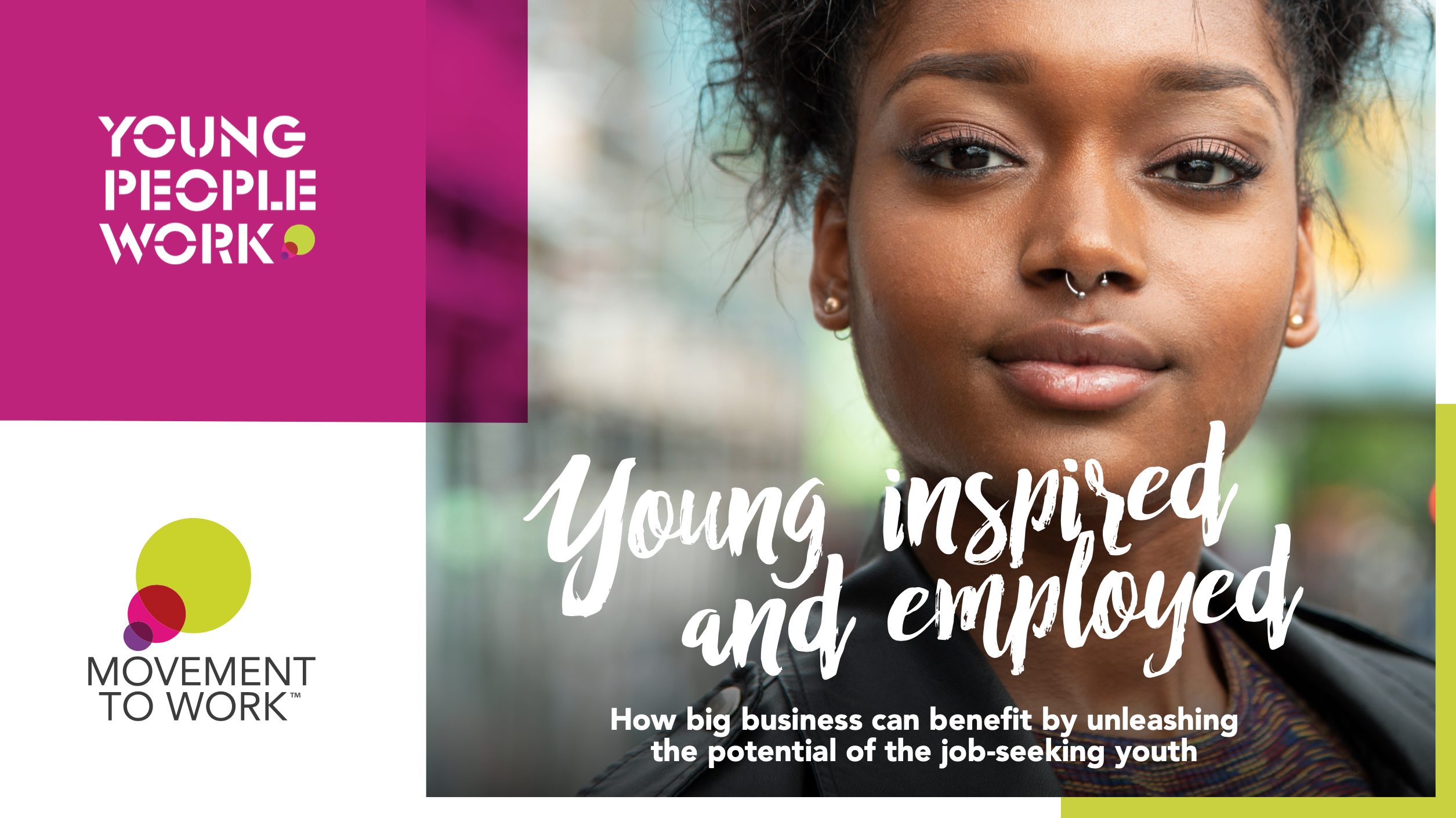
The Large Employers and the Youth Labour Market research report commissioned by Movement to Work and Youth Futures Foundation, and co-sponsored by Accenture and Sage, looks at how large employers engage with youth employment programmes and examines ways they can do it better and make a more meaningful impact.
In response to the research findings, Movement to Work, with the help of Accenture, have created Young, Inspired and Employed — an employer facing summary of the report — focussed on core insights, key benefits and actionable recommendations.
Movement to Work is a not-for-profit coalition of UK employers, youth-outreach organisations, training providers and government allies – all aiming to level the playing field for young people aged 16-30 facing barriers to work. As a robust delivery partner, Movement to Work works with employers to design bespoke youth employability programmes, either in-house or through one of their recommended training providers. With hundreds of organisational members, Movement to Work has a proven track record of driving social mobility with over 125,000 work placements delivered to date, made possible by employers, charities and government working together. Collectively Movement to Work has provided young people with diverse and empowering experiences ranging from hospitality to engineering, with regional hubs working in London, the Midlands, North East and North West to make a real difference nationwide.
The Movement to Work membership includes some of the biggest UK employers including Accenture, Unilever, Tesco, Marks & Spencer, BT, BAE Systems, Sage, Salesforce, Barclays, Centrica, Diageo, HSBC, IBM, Marriott, NHS, Department for Work and Pensions, and the British Army.
Movement to Work’s support is free of charge and can provide employers with tools and connections from beginning to end. All that is asked in return is that employers create quality opportunities for young people.
For more information on how your business can improve its engagement with youth employment initiatives and maximise the benefits, reach out to Movement to Work and get started today.
Contact us: info@movementtowork.com
A new report by lesbian, gay, bi and trans equality charity Stonewall and BritainThinks –Shut Out –reveals stark findings for LGBT young people who are not in education, employment or training (NEET).
The research shows that anti-LGBT bullying, lack of support at home or visible role models can have a devastating impact on LGBT young people’s mental health, and lead many to being ‘shut out’ of higher education and work. The report finds that once out of school and employment, LGBT young people are slipping through the gaps and face significant obstacles to re-entering education and work.
Key findings show why these young people left education, training and employment, including:
The report goes on to show that once out of education and employment, mental health struggles and difficulties accessing opportunities continue to hold LGBT young people back and prevent them from reaching their full potential.
To see the full report and additional commentary from Stonewall and BritainThinks, click here.